PkPaperka
Back to tools

Games, review, and group learning

Create custom printable bingo cards

Build a playable bingo set from a prepared theme or your own vocabulary, questions, actions, or event prompts. Choose the board size, create several differently arranged cards, preview the exact layout, and download a print-ready PDF with an optional caller sheet.

1-6 cards + caller sheetOne list, many boards

Exact first-card preview

Your bingo set

Animals5 × 5 board4 cards
Vocabulary BingoCard 1 of 4
Name:
FROG
PANDA
HORSE
TURTLE
PENGUIN
KOALA
SHARK
SEAL
FOX
DOLPHIN
SNAKE
TIGER
FREE
RABBIT
BEE
MONKEY
OCTOPUS
ZEBRA
EAGLE
ELEPHANT
WHALE
OTTER
PARROT
LEOPARD
KANGAROO

Mark a complete winning pattern and call BINGO.

What does this bingo card generator create?

It turns one prepared theme or custom prompt list into one to six deterministic bingo boards. Every card draws from the same pool but shuffles the square order independently, supports an optional free center on odd grids, and can append a caller checklist containing the complete accepted prompt set.

How do I prepare and print a complete bingo set?

Choose a grid that fits your time and group, confirm the list has enough unique prompts, generate at least one card per player or team, and include the caller sheet. Print at actual size on Letter or A4 paper. Card stock is useful for repeated play; ordinary paper works well with pencils, counters, or reusable sleeves.

What can custom bingo be used for?

Use it for vocabulary listening, sight-word recognition, definitions, math facts, science review, movement breaks, conversation prompts, book clubs, staff icebreakers, birthday parties, holiday activities, road trips, scavenger hunts, and family game nights without requiring an account or design software.

Rules of the game

How to play printable bingo

Before the first call, give every player or team one card and agree on the winning pattern. One person acts as caller and announces prompts in a random order.

1. Choose the winning pattern

A common win is one complete horizontal, vertical, or diagonal line. For a shorter or different game, use four corners, an X, a picture-frame border, or a completely marked board.

2. Announce one prompt at a time

The caller draws or chooses an unused prompt, says it clearly, and marks it on the caller checklist. For learning games, the caller can give a definition, clue, translation, equation, or mime instead of reading the answer.

3. Players find and mark matches

Each player checks only their own board and covers the matching square with a counter or pencil mark. The center FREE square counts as already marked when that option appears.

4. Call and verify BINGO

A player announces BINGO as soon as the agreed pattern is complete. The caller compares the marked squares with the announced checklist; if every match is valid, that player wins the round.

Design a better bingo activity

Turn a random grid into a purposeful group activity.

The strongest bingo set combines enough variation for fair play with prompts that match the audience, the available time, and the learning goal.

Match board size to attention span

Use 3 × 3 for a five- to ten-minute warm-up or younger children. A 4 × 4 board suits a medium session without a free square, while 5 × 5 supports longer review and more varied winning patterns.

Provide enough unique prompts

With a free center, fully filled 3 × 3 and 5 × 5 cards need 8 and 24 prompts. A 4 × 4 card needs 16. Extra prompts make cards differ more and reduce simultaneous wins.

Keep square text scannable

Single words and short phrases are easiest to locate quickly. Longer questions can work on a 3 × 3 board, but a crowded 5 × 5 card should use concise labels and move explanations to the caller's spoken clues.

Generate different cards fairly

Give participants cards from the same generated set so everyone hears the same prompt pool while square positions differ. Use a new variation for another class, table, round, or event.

Make retrieval active

Instead of calling the printed word, read a definition, show a picture, solve an equation, pronounce a foreign-language equivalent, or describe an example. Players must retrieve the matching answer before marking it.

Plan how marks will be made

Pencils are simple for one use. Buttons, paper circles, dry beans, or counters allow replay. Laminated cards or clear sleeves work with dry-erase markers and reduce printing for recurring groups.

Use the caller sheet as evidence

Check each prompt immediately after announcing it and keep the sheet visible during verification. This resolves disputed wins and makes it easy to resume after a pause without repeating an item.

FAQ

Printable bingo generator FAQ

How many prompts do I need for each board size?

With the free center enabled, 3 × 3 needs 8 unique prompts and 5 × 5 needs 24. A 4 × 4 board has no center square and needs 16. If the list is shorter, the generator clearly adds write-in squares instead of silently duplicating prompts.

Are all generated bingo cards different?

Each card uses an independent deterministic shuffle from the same prompt pool. With a sufficient list, this produces different square arrangements while keeping the game fair because every participant draws from the same vocabulary.

Can I use phrases, questions, or actions instead of single words?

Yes. Spaces and punctuation are preserved. Each unique entry can contain up to 32 characters, which accommodates short questions and instructions while keeping text readable inside a printable square.

Why is the free square unavailable on a 4 × 4 board?

Even grids do not have one geometric center cell. The generator therefore uses all 16 squares for prompts and reserves the optional free center for 3 × 3 and 5 × 5 cards.

What is included on the caller checklist?

It lists every accepted unique prompt from the active theme or custom list, not only the subset visible on the first card. The caller can check items in place or cut the boxes apart for a random draw.

Can multiple people play from one PDF?

Yes. Choose up to six cards and print one board per participant or team. For a larger group, create another variation and keep the prompt list unchanged so the caller sheet still matches.

What does the variation number control?

It controls the deterministic order used for every card. The same prompts, grid, card count, and variation number reproduce the same boards; New card set creates a fresh arrangement.

Is the bingo generator free and watermarked?

It is free to use, requires no sign-in, and adds no watermark. The PDF is generated directly in Letter or A4 format with the selected colors, orientation, card count, and optional caller page.
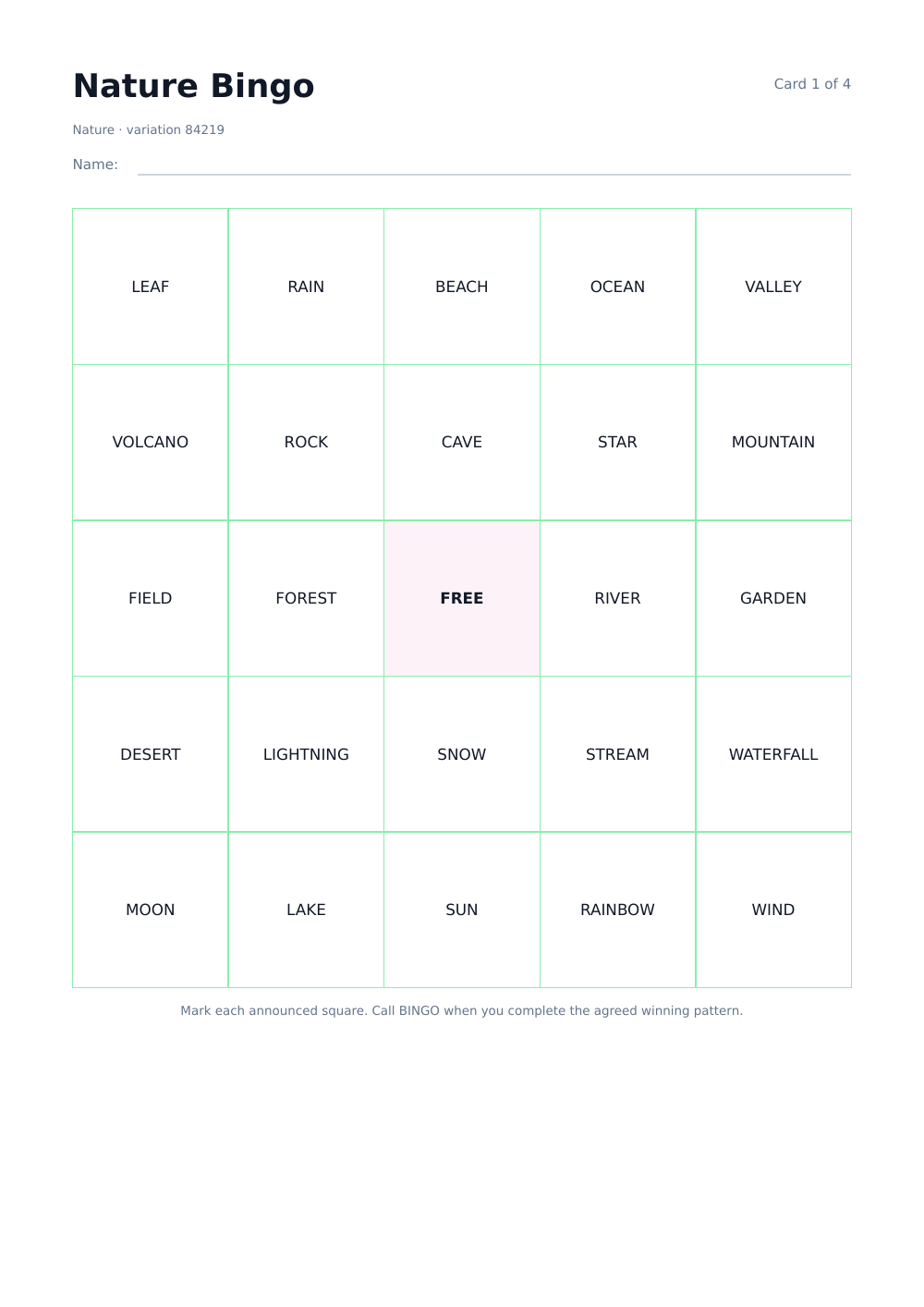
Practical printing guide

How to get a clean printable result.

Small print settings can make a large difference with worksheet-style PDFs. Use these notes before printing a full batch, especially when you are preparing pages for a class, binder, planner, or repeated weekly routine.

Use actual size

Print the downloaded PDF at 100% or actual size when spacing matters. Fit-to-page can shrink ruled lines, grid squares, flashcards, and planner boxes enough to make writing space feel cramped.

Match the paper

Choose US Letter or A4 before downloading. The generated PDF uses that page size directly, so selecting the same size in the printer dialog prevents unexpected margins or clipped edges.

Test one page first

For new templates, print a single page before making copies. Check line contrast, writable space, margins, and whether the page works better in portrait or landscape orientation.

Save repeat setups

When a layout works, bookmark the configured page. The controls are reflected in the URL, which makes it easy to return to the same printable without rebuilding it from scratch.