Pk Paperka
Back to tools

Math worksheet

Generate printable math worksheets

Create arithmetic practice sheets with operation type, difficulty, problem count, columns, name/date fields, and an optional answer key.

PDF exportArithmetic practice

Live preview

Your worksheet

AdditionMedium24 problems
Math PracticeName:
1.12 + 8 =2.34 - 9 =3.6 x 7 =4.12 + 8 =5.34 - 9 =6.6 x 7 =7.12 + 8 =8.34 - 9 =9.6 x 7 =10.12 + 8 =11.34 - 9 =12.6 x 7 =13.12 + 8 =14.34 - 9 =15.6 x 7 =16.12 + 8 =17.34 - 9 =18.6 x 7 =19.12 + 8 =20.34 - 9 =21.6 x 7 =22.12 + 8 =23.34 - 9 =24.6 x 7 =

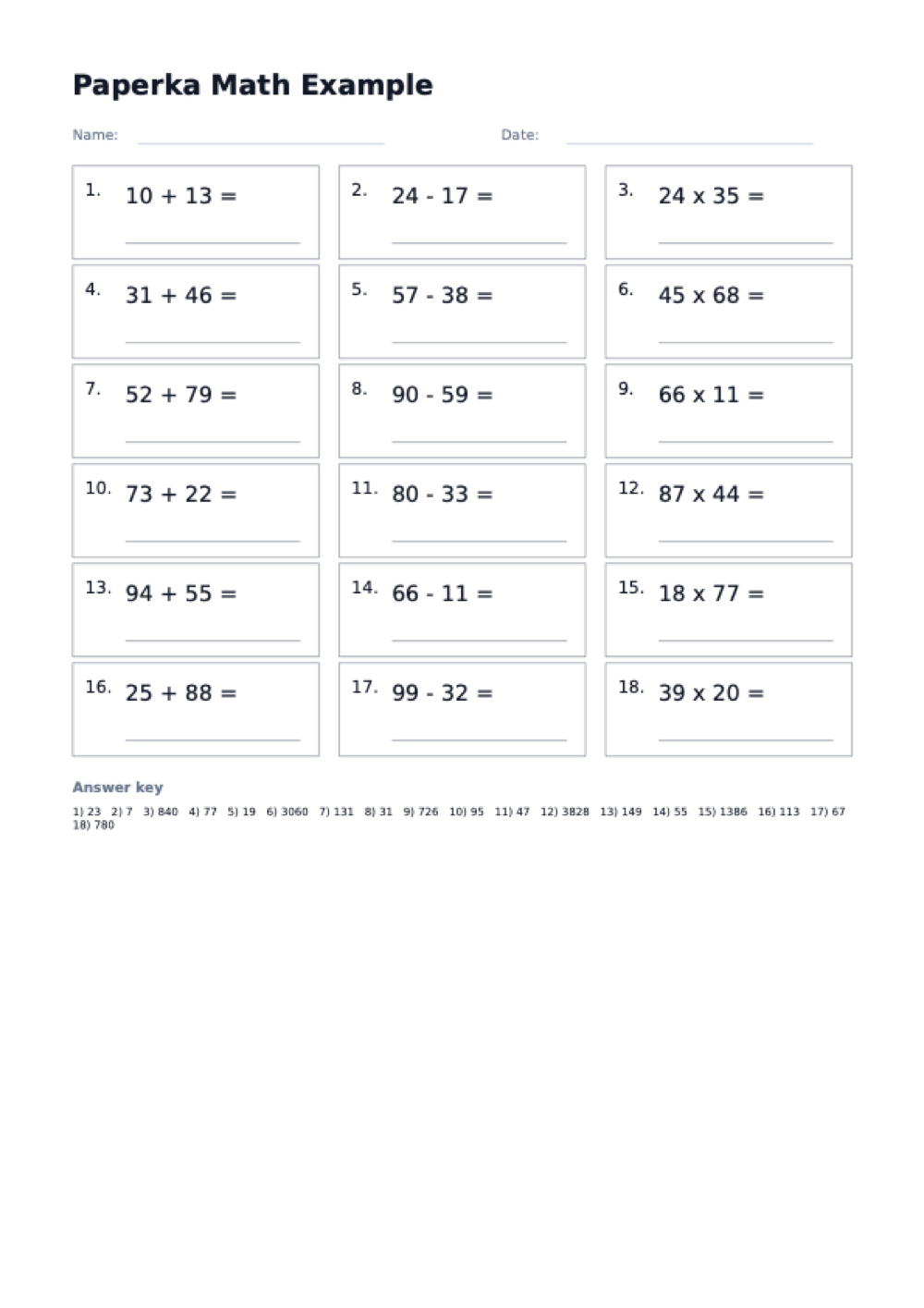
Actual output

A real page from this generator

An unedited A4 worksheet of mixed arithmetic as it downloads, laid out in columns with room to work under each problem. Its answer key is generated from the same problems and appears at the bottom of this example page.

Open the complete example PDF
Printable A4 mixed arithmetic worksheet with numbered problems arranged in columns

What is a math worksheet generator?

A math worksheet generator produces arithmetic problems and can calculate an optional answer key from the same problem set. Operations cover addition, subtraction, multiplication, and a mixed set; three difficulty bands control the size of the numbers involved; and the problem count and column layout decide how much working space each problem gets.

Columns, problem count, and room to show working

Three columns of 60 problems makes a dense fluency sheet with limited working room. If you want to see the method, use one or two columns at a lower count. The optional answer key appears below the problems, so create a separate teacher copy with the key enabled when learner copies should not show it.

Drills, diagnosis, and why the answer key matters

A high count at low difficulty is a fluency drill, timed and repeated. A low count at high difficulty is a diagnostic, where you read the working rather than the score. The mixed operation set is the one that finds learners who have memorised procedures without knowing which to apply, because it removes the cue that a page of pure subtraction gives away. Answer keys make the sheet usable by a substitute, a parent, or the learner marking their own work.

Operation, difficulty, count, columns

How to build a worksheet that teaches something

The four settings correspond to four separate decisions, and the most consequential one is the pairing of count and columns, because that is what decides whether a learner can show their working.

1. Choose the operation to match what you are testing

A page of one operation practises fluency in that operation. The mixed set tests something different: whether the learner can decide which operation applies. Both are useful, and using the mixed set when you meant to drill subtraction produces a page that frustrates a child who is still learning it.

2. Set difficulty by the numbers, not by the year group

The difficulty bands control the size of the operands rather than any curriculum level. Look at one generated page and judge it against what the learner can currently do without counting on fingers. Sitting one band below that is where fluency practice belongs.

3. Pair a high count with fluency and a low count with method

Forty to sixty problems in two or three columns is a timed fluency drill and should be marked on speed and accuracy. Ten to twenty problems in one column leaves room to show working, and should be marked by reading the method. Using a high count when you wanted to see the method leaves nowhere to write.

4. Add the answer key only when it belongs on that copy

When enabled, the key is calculated from the same problems and appears below them on the worksheet page. For a teacher copy, download once with the key enabled; for learner copies, turn it off before downloading or printing those pages.

Worksheet notes

Keep arithmetic practice focused and printable.

Good math worksheets give enough repetition without crowding the page. Match difficulty and problem density to the student's handwriting size and current fluency.

Start with one operation

Use addition, subtraction, or multiplication worksheets when a student is learning a specific skill. Mixed practice is better for review after the basics are stable.

Use fewer columns for younger students

One-column pages leave more writing room. Two and three columns are useful for quick drills, older students, or compact review sheets.

Add answer keys when preparing sets

Answer keys help when creating classroom packets, tutoring materials, or independent practice pages that need quick checking.

Adjust difficulty gradually

Move from one-digit to two-digit and three-digit problems when accuracy is consistent, not just when speed improves.

Vary one setting to get a genuinely different sheet

Identical settings reproduce the identical worksheet, which is useful when you want the same page again and unhelpful when you want a second one. Changing the problem count is the smallest edit that redraws every number, so two learners can have different sheets at the same difficulty.

Mark the working, not just the answer

A correct answer from a wrong method is a problem waiting to reappear, and a wrong answer from sound method is nearly a success. This is the argument for lower problem counts on diagnostic sheets: you cannot mark what the learner had no room to write.

FAQ

Math worksheet FAQ

Can I generate an answer key?

Yes. Turn on the answer key option and the PDF adds a solutions section below the problems on each worksheet page. For a teacher-only copy, download once with the key enabled and then disable it before producing learner copies.

Are the problems different every time I download?

No. The problems are derived from the settings rather than drawn at random, so the same operation, difficulty, and problem count always produce the same sheet. To give two learners different pages, or to build a multi-day packet, change a setting: the problem count, the operation, or the difficulty each shift the numbers.

Can I mix addition, subtraction, and multiplication on one page?

Choose the mixed operation and the generator alternates between all three operations on the same sheet. If you want a single skill instead, pick addition, subtraction, or multiplication on its own.

How many problems fit on one page?

You control it directly: set anywhere from 6 to 60 problems and 1 to 3 columns. Fewer problems in one column leave large writing space for young students, while 60 problems in three columns make a dense timed drill.

What do the difficulty levels actually change?

Difficulty sets the number size: easy uses 1-digit numbers, medium 2-digit, and hard 3-digit. It applies to whichever operation you choose, so you can have easy multiplication or hard subtraction.

Is this worksheet generator free to use?

Yes, completely free with no signup and no watermark on the PDF. Your settings are encoded in the page URL, so you can bookmark a configuration and regenerate the same style of worksheet any time.